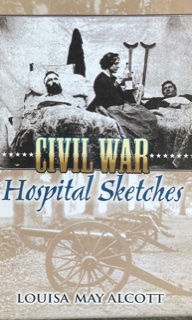
Better known for her popular books, Little Women, Little Men, and Jo’s Boys , Louisa May Alcott ‘s book, Civil War Hospital Sketches, invites the reader into the hospital wards of Washington, DC to see the war from her perspective as a Union Army nurse. Alcott enlisted in Boston, leaving her quiet life to serve in a hospital set up in the Willard Hotel just after the Battle of Fredericksburg, December 1862, that left 16,754 Americans (12,653 Union and 4,201 Confederate soldiers) dead and hundreds grievously wounded. Written as letters to home in the character of “Nurse Tribulation Periwinkle,” the letters were later published in the antislavery journal, Commonwealth, and then bound as a short book. She begins her service as hundreds of rough, mule drawn ambulances bring wounded soldiers from the battlefields into Washington, even today a walk of 18 1/2 hours under better circumstances. Her letters were written hastily and often after a long exhausting day, but her powers of description give the reader a unique window into the workings of the hospital and the contemporary state of medicine as well as the struggles for life and, and often, the deaths of injured men.
Union Hospital of Georgetown was poorly ventilated and very crowded with men on cots side by side in a former ballroom. With only wash basins, simple soap and rags, nurses washed mud off men brought straight from the battlefield, spoon fed them soup, and sat through the night to sponge and cool their feverish bodies. Sometimes nurses could write a letter home for patients or sit briefly to chat.
“Nurse Periwinkle” describes her dearest patient, John from Michigan, as courageous, sober, self-denying, and kind with “the serenest eyes I ever met.” Although suffering from grievous injuries from cannon fire in his chest, lungs, and back back and lungs, he never asked her for comfort thinking other men must need it more or that she might be tired. She willingly gave once she realized his long-suffering, uncomplaining nature. He was in constant, excruciating pain with no drugs to alleviate or surgery to repair available. She said, “Let me help you bear it” and did what she could to encourage him. He responded with swift, complete, and quiet gratitude,
She learned that he was 30 years old and had a “settled” nature then often associated with a married man. For 10 years he had taken care of his widowed mother, younger sister who was too young to be married with home of her own, and his younger brother who still needed to learn a trade to support them, “for we are not rich.” Alcott asked him why he would enlist but not marry. He responded, “Enlisting is helping my neighbor, marrying if pleasing myself” and he would sacrifice himself.
As with other genuine, collected Civil War letters (see Tuff as a Boiled Owl, Letters of Proctor Spalding compiled by Kenena Hansen Spalding), the letters refer to some events and use contemporary, idiomatic language not well known now. Some sentiments, couched in unfamiliar terms, sound to the modern ear as racist or sexist (even against Alcott’s own religious, political persuasion and own female sex). Although Alcott is from a staunch abolitionist family and dedicated to the rights of all, she phrased some observations through the lens of her times. She understood that people were grievously displaced from their homes and wounded by generations of enslavement and deprivation, but her adjectives to describe them sometimes reflect the many ethnocentric contradictions that helped to establish slavery in the first place. She reflects negative characteristics that were or were not actually present and contrasts them to positives characteristics that are equally lacking in nuance. She is right that this is a question of “the liberty of both the races” because no one can be free when our neighbors are enslaved.
“Here was the genuine article no — not the genuine article at all, we must go to Africa for that — .but the sort of creature generations of slavery have made them: obsequious, trickish, lazy and ignorant, yet kind-hearted, merry-tempered, quick to feel and accept the least token of the brotherly love which is slowly teaching the white hand to grasp the black, in this great struggle for the liberty of both the races.”
While the modern reader may find Alcott behind our contemporary standards of fullest equality, one may forgive her to some degree because she and her family were ahead of the curve of the time although even the staunchest abolitionists could be white ethnocentric and patriarchal — not yet accepting their own parts in the great national sins of slavery and economic exploitation.
Nurse Periwinkle recounts the joy she experienced in her garret room at midnight Dec 31, 1962 when the church bells of Washington, DC tolled to announce and ring in the Emancipation Proclamation of Jan 1, 1863.
Alcott contracted a life-threatening case of typhoid fever and took to her attic cot to recover. She noted the kindness of the staff to her with people bringing her food and even exhausted surgeons coming into her room in the middle of the night with wood and kindling they had chopped themselves to keep her fire going so she would not find herself in a stone cold room at 3 a.m. shivering with no strength or supplies with which to warm her tiny room. She roused from a fever once to see her old father sitting at her bedside, ready to take her home to Boston once well enough to travel. Alcott lasted only 6 weeks in the harsh hospital environment and was never fully well again. “Never sick before her service and never well after it,” she experienced delirium, “visions,” and weakness for the rest of her life. Her Sketches remain as a sample of, and testament to, the sufferings of war. Especially in a civil war (more aptly named, an “UNcivil” war) where citizens and siblings turn against each other, oceans of sorrow, blood and mud, can hardly be imagined, must less described.
 Susan Olmstead Wang